How Modern Anti-Fraud Systems Analyze Users and Why an IP Address Alone Is No Longer Enough

Inhalt des Artikels
- How modern anti-fraud systems work
- Why ip addresses still matter
- Browser fingerprint: a digital browser fingerprint
- User behavior matters too
- Why consistency across all parameters matters
- What network signals do modern platforms analyze?
- How to build an infrastructure that looks natural
- Why choosing a reliable proxy provider matters
- Conclusion
When users encounter an account suspension or an additional verification request, the first thing that usually comes to mind is that the problem lies with their IP address. As a result, many start looking for a new proxy or switching to a different location, assuming that this alone will solve the issue.
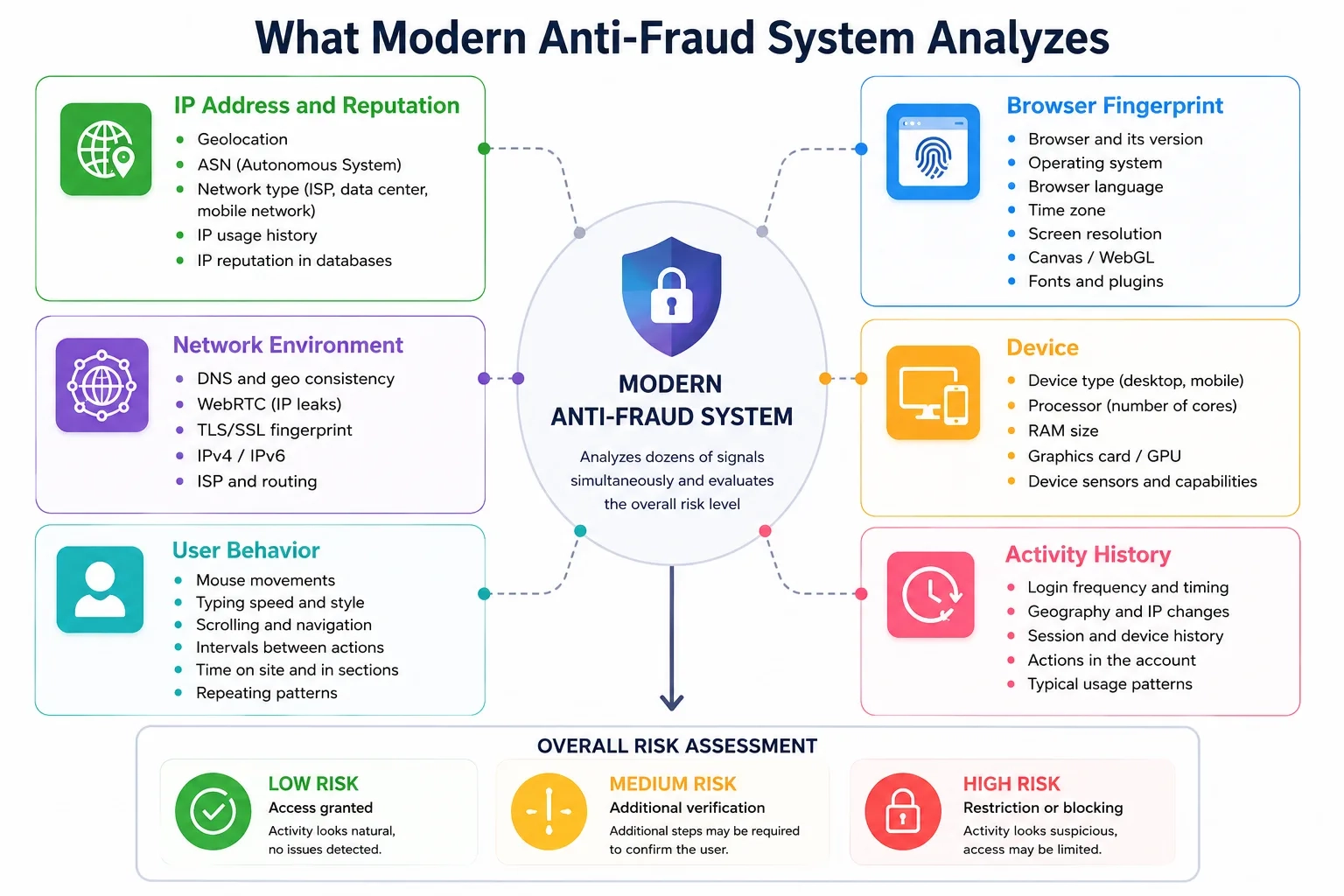
A few years ago, that approach often worked. However, modern anti-fraud systems have become far more sophisticated. Today, they evaluate not only the IP address but also dozens of other signals, including device characteristics, browser configuration, network environment, and user behavior. This is why two users connecting from identical IP addresses can experience completely different outcomes: one may continue working without any issues, while the other is asked to complete additional verification.
In this article, we'll explore the factors modern anti-fraud systems take into account, explain why an IP address alone is no longer enough, and discuss how to build an infrastructure that appears natural from the perspective of online platforms.
How Modern Anti-Fraud Systems Work
The primary goal of any anti-fraud system is to determine whether a user's activity resembles the behavior of a real person.
To achieve this, platforms analyze much more than just an IP address. They also evaluate device characteristics, browser configuration, network environment, activity history, and user behavior throughout the session.
Some of the key signals that may be analyzed include:
- IP address and its reputation;
- Network environment;
- Browser Fingerprint;
- Device characteristics;
- User behavior;
- Previous session history.
On their own, these signals rarely lead to an account restriction. However, when multiple inconsistencies appear at the same time, the platform's confidence in the session decreases.
For example, imagine a user logging in from a US IP address while using a Japanese time zone, a German browser language, and device characteristics that contradict one another. Although each of these settings may seem perfectly valid on its own, together they create a combination that can appear suspicious. Rather than evaluating individual parameters in isolation, modern anti-fraud systems assess the overall picture.
Why IP Addresses Still Matter
Although today's anti-fraud systems analyze dozens of different signals, the IP address remains one of the first pieces of information every website receives.
An IP address can reveal:
- the user's country and region;
- their internet service provider or mobile carrier;
- the Autonomous System Number (ASN);
- whether the address belongs to a data center or a residential network;
- the history of IP usage;
- its reputation.
If an IP address has previously been associated with spam campaigns, large-scale automated registrations, or other suspicious activity, that information may already be available to anti-fraud services.
However, it's important to understand that even a "clean" IP address no longer guarantees trouble-free operation.
Consider two scenarios.
In the first, a user logs in through a dedicated ISP proxy, uses the same browser profile every day, works during their usual hours, and always connects from the same location. From the platform's perspective, this activity appears consistent and natural.
In the second scenario, the same IP address is used together with a newly created browser profile, constantly changing time zones, different interface languages, and multiple devices. Despite the high-quality IP, the likelihood of triggering additional verification becomes significantly higher.
This is why an IP address is now just one component of a much broader risk assessment.
Browser Fingerprint: A Digital Browser Fingerprint
One of the key tools used by modern anti-fraud systems is the Browser Fingerprint — a unique digital fingerprint created from a browser's technical characteristics.
Every browser shares a variety of information with the websites it visits, including the operating system, browser version, screen resolution, interface language, time zone, graphics settings, and other technical parameters. Individually, these details reveal very little. Combined, however, they create a unique device profile.
Based on this information, online platforms evaluate whether a connection appears natural. For example, if a browser reports that it is running on a modern MacBook while simultaneously exposing characteristics typical of an older Android device, such inconsistencies may increase the risk score.
This is why professionals managing multiple accounts often use anti-detect browsers. Rather than simply modifying individual parameters, these tools help create a consistent browser profile in which all characteristics logically match one another.
User Behavior Matters Too
Technical parameters are only part of the picture.
Modern platforms increasingly analyze how users interact with a website during a session.
Behavioral signals may include:
- typing speed;
- mouse movement;
- cursor trajectory;
- time intervals between actions;
- scrolling behavior;
- navigation patterns;
- session duration;
- frequency of repeated actions.
For example, if a user logs in and performs dozens of identical actions within seconds using perfectly consistent time intervals, that behavior differs significantly from normal human activity.
This does not mean that any form of automation will automatically result in an account restriction. However, modern anti-fraud systems are capable of detecting highly predictable behavior patterns and incorporating them into their overall risk assessment.
As a result, many automation tools now support random delays, varied interaction patterns, and other techniques designed to make automated workflows appear more natural.
Why Consistency Across All Parameters Matters
One of the most common mistakes is trying to make a connection as anonymous as possible.
In practice, modern platforms are rarely concerned with whether users are hiding their identity. What matters far more is whether the entire digital environment appears logical and consistent.
For example, if a user genuinely operates from Germany, uses a German browser language, a European time zone, and a German ISP, that combination appears natural.
On the other hand, if the IP address belongs to one country, the browser language to another, the time zone to a third, and the reported device characteristics contradict one another, the likelihood of additional verification increases.
For this reason, the goal today is not maximum anonymity, but ensuring that all elements of the digital environment are consistent and align with one another.
What Network Signals Do Modern Platforms Analyze?
When discussing anti-fraud systems, most people think of IP address checks or browser fingerprinting. In reality, modern platforms analyze a much broader range of network-related signals.
For example, they may evaluate whether the DNS server matches the selected location, whether WebRTC exposes the user's real IP address, which TLS version is used to establish secure connections, and which Autonomous System (ASN) the IP address belongs to.
Individually, these signals rarely result in restrictions. Together, however, they help platforms determine whether a connection appears legitimate.
For example, if a user connects through a French IP address while DNS requests are routed through servers on another continent, it may raise additional concerns. The same applies when the browser reports one set of network characteristics while the actual connection suggests a completely different device or network.
For this reason, managing multiple accounts requires paying attention not only to the proxy itself, but also to the entire network environment.
How to Build an Infrastructure That Looks Natural
It is impossible to eliminate the risk of additional verification entirely. Anti-fraud algorithms continue to evolve, and every platform applies its own detection methods.
However, following a few best practices can significantly improve long-term stability.
- Use one IP address per account. If an account is intended for long-term use, assigning it a dedicated IP is generally the safest approach.
- Keep your settings consistent. The IP location, browser language, time zone, and other parameters should match each other.
- Avoid changing IP addresses unnecessarily. Frequently switching IPs during an active session may appear less natural than maintaining a stable connection.
- Separate different projects. If you manage multiple services or accounts, use separate browser profiles and dedicated proxies whenever possible.
- Test before scaling. Even high-quality proxies should be tested on a small workload before being deployed in larger projects.
Why Choosing a Reliable Proxy Provider Matters
Today, proxy quality is determined by much more than connection speed or the size of the IP pool.
Network stability, geographic coverage, proxy variety, and convenient management tools all play an important role.
For example, if one project requires long-term account management while another focuses on large-scale data collection, using several different proxy providers can make infrastructure management unnecessarily complicated.
In such cases, it is often more practical to choose a platform that offers multiple proxy types in one place.
One such solution is MangoProxy. The platform provides residential, ISP, mobile, and datacenter proxies, allowing users to select the most suitable proxy type for each specific task without relying on multiple providers.
MangoProxy offers access to more than 90 million IP addresses across 200+ countries, supports HTTP, HTTPS, and SOCKS5 protocols, and provides an API for automated proxy management.
For projects where high speed and connection stability are essential, static datacenter proxies are an excellent choice. When placing an order with MangoProxy, you can use the promo code STATIC15 to receive 15% off static datacenter proxies.
Conclusion
Modern anti-fraud systems no longer evaluate users based solely on their IP addresses. Instead, they analyze a combination of factors, including the network environment, browser characteristics, device configuration, activity history, and user behavior.
Building a stable infrastructure is no longer about finding the "perfect" IP address. It is about creating a consistent digital environment in which every element works together naturally. The more authentic a user's digital profile appears, the less likely it is to trigger additional verification.
High-quality proxies remain an essential part of that infrastructure. However, the best results are achieved when they are combined with a properly configured browser, a consistent network environment, and realistic usage patterns. Taking a comprehensive approach helps reduce the likelihood of restrictions and enables more stable interactions with modern online platforms.